From Tinkering to Trust: The Evolution of My Homelab
Over the past decade, my homelab has evolved from humble beginnings—a cheap Netgear Wi-Fi router paired with VirtualBox running on an old Acer Windows PC—into what it is today. Like most long-running homelabs, the changes weren’t driven purely by technology, but by life.
Many of the decisions I made early on reflected where I was at the time. Reliability and redundancy weren’t high priorities back then. I had more time to tinker, break things, and rebuild. These days, time is limited, and the data I’m responsible for—family photos, personal projects, and services others rely on—is far more valuable. Naturally, my priorities have shifted.
Early Networking: From Consumer Gear to pfSense
I started out with an old Netgear Nighthawk and quickly ran into the limitations of factory firmware. After about a year of research and saving, I built my first custom firewall for around $350. It was powered by a quad-core Intel Celeron with dual Intel NICs and ran pfSense.
That setup was my real introduction to networking, firewall security, and system management. It served me well for many years, but it wasn’t without frustration. Every once in a while, I’d unintentionally nuke the configuration and have to restore from a backup. At first, breaking and fixing things was part of the fun. Over time, though, that cycle started to wear thin.
Virtualization: Goodbye VirtualBox, Hello Proxmox
Around the same time, I discovered Proxmox and decided it was time to move on from VirtualBox and Windows altogether. I made the jump to Proxmox VE 6 and haven’t looked back since.
Proxmox was a game changer. Moving to a true type-1 hypervisor dramatically improved the stability of my environment. My self-hosted services now sit comfortably at around 99.9% uptime. No more Windows. No more VirtualBox. Just Debian-based Linux doing what it does best.
Proxmox LXCs gave me lightweight containers for most services, while QEMU/KVM virtual machines covered the cases where I needed full virtualization. The flexibility and reliability were exactly what I was looking for.
Networking Maturity: Embracing UniFi
After moving into our house in 2019, one of the first upgrades I made was adding a UniFi access point, paired with a 16-port UniFi PoE switch. For years, I self-hosted the UniFi Network application in Proxmox and gradually grew to appreciate the UniFi ecosystem.
Following much-needed polish and improvements in the UniFi Network application—especially around version 9—I finally decided to go all in and picked up the UniFi Dream Machine Pro Max. I absolutely love it.
At this point, a UniFi network feels incomplete without one of their gateways. Moving from pfSense to UniFi was a deliberate trade-off: less tinkering, more stability, and far better integration. I don’t regret the switch at all.
Services I Run on Proxmox
Today, Proxmox is the backbone of my homelab, running a mix of containers and virtual machines that support both infrastructure and everyday life:
- Ansible – automation
- Cloudflared – Zero Trust network access
- Docker – containerization
- Graylog – log collection, management, and alerting
- Ghost – hosting this blog
- Jellyfin – media server and client
- Mealie – recipe management
- Nginx – reverse proxy for self-hosted apps
- ntfy – webhook-based push notifications
- Sonarr – TV show management
- Radarr – movie management
- Prowlarr – indexer management
- qBittorrent – media downloads
- Vaultwarden – password and secrets management
- Uptime Kuma – homelab uptime monitoring
Current Hardware
My current setup strikes a balance between performance, efficiency, and reliability:
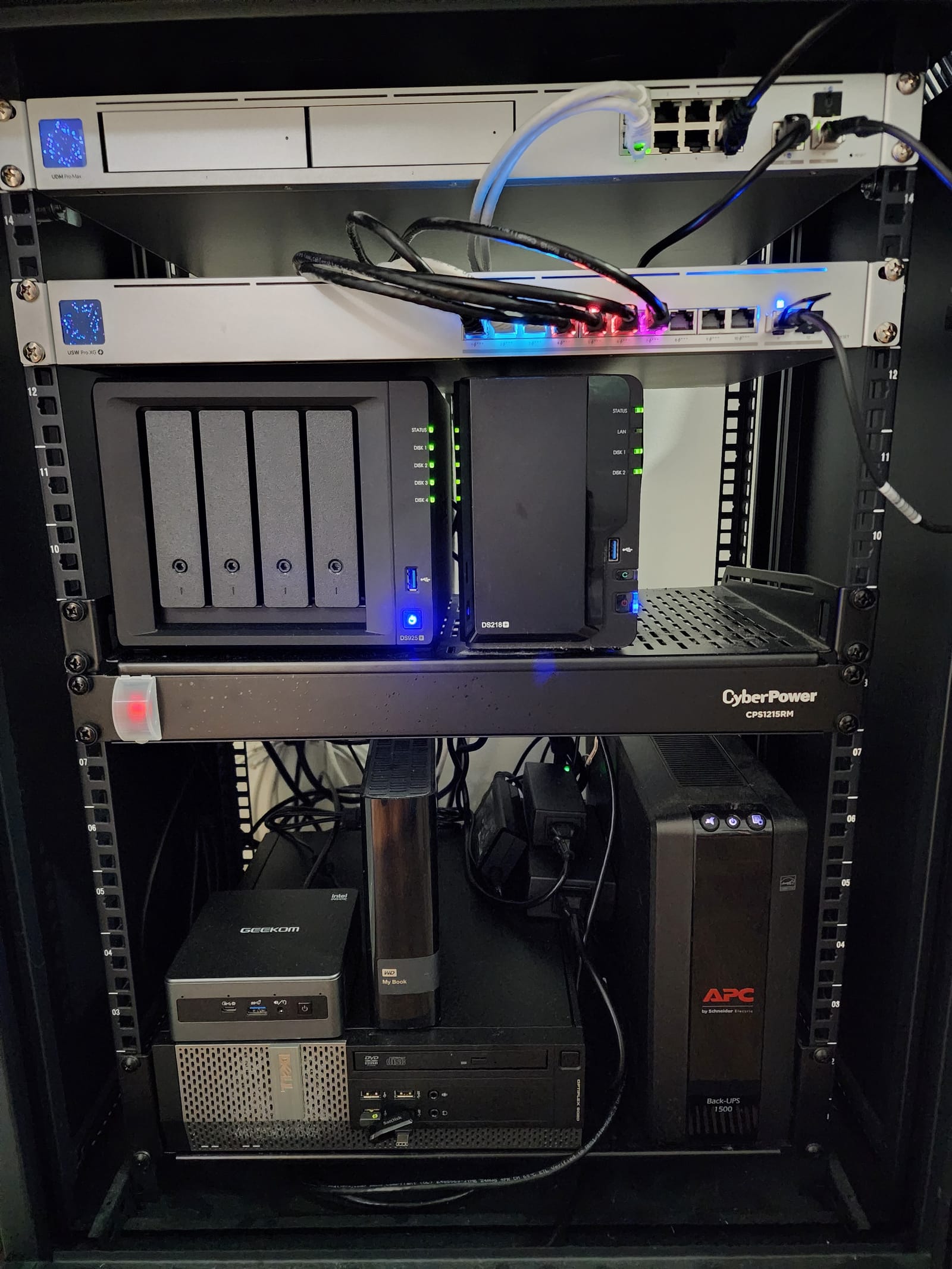
- Gateway / Firewall: UniFi Dream Machine Pro Max
- Switch: UniFi USW Pro XG 10 PoE
- Proxmox Server: Geekom IT11 Mini PC (64 GB DDR4)
- Storage: Synology DS925+ and DS218+
- UPS: APC Back-UPS 1500
Closing Thoughts
My homelab today isn’t about squeezing every last feature out of the stack or endlessly rebuilding things just because I can. It’s about trust. Trust that my services will be there when I need them. Trust that my data is safe. Trust that I can spend less time fixing infrastructure and more time enjoying the results of it.
I still tinker—but now it’s intentional. The lab has grown up alongside me, evolving from a playground into dependable infrastructure. And honestly, that shift has been one of the most satisfying upgrades of all.